Published: April 24, 2026 at 3:26 pm
Updated on April 24, 2026 at 5:04 pm

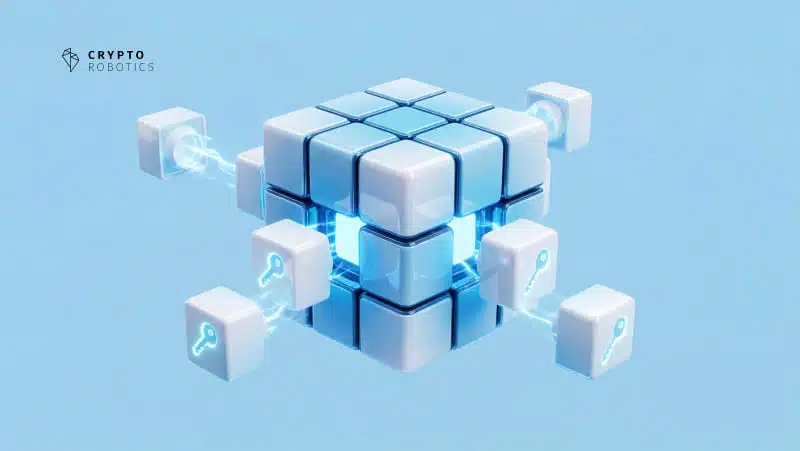


Most digital systems today operate on a simple trade-off: to prove something, you have to reveal it.
If you want to verify your identity, you share personal data.
If you want to prove a transaction, you expose its details.
Zero-knowledge proofs (ZKPs) challenge that assumption.
They allow one party to prove that something is true — without revealing why it is true or exposing the underlying data.
This idea sounds abstract at first, but it has become one of the most important building blocks in modern cryptography, especially in blockchain systems where privacy and transparency need to coexist.
Understanding zero-knowledge proofs explained in simple terms is less about math and more about grasping a different way of thinking about verification.
A zero-knowledge proof is a cryptographic method that allows one party (the prover) to convince another party (the verifier) that a statement is true, without revealing any additional information.
That definition is precise, but not intuitive.
The key idea is simple:
You can prove knowledge without revealing the knowledge itself.
Imagine you know the password to a system.
In a typical setup, you would enter the password, and the system checks if it matches.
With a zero-knowledge approach, you don’t send the password at all.
Instead, you prove that:
The system verifies your proof mathematically.
No password is transmitted. Nothing can be intercepted.
This is the core idea behind zero-knowledge cryptography.
At first glance, this might seem like an academic concept. It’s not.
Zero-knowledge proofs solve a real and growing problem:
How to verify information without exposing sensitive data.
This becomes critical in:
In traditional systems, verification requires trust or exposure.
ZKPs remove both.
At a high level, ZKPs rely on three properties:
If the statement is true, the verifier will be convinced.
If the statement is false, it cannot be convincingly proven.
No additional information is revealed beyond the validity of the statement.
Without going deep into math, the process looks like this:
The important detail: verification is fast, even if proof generation is complex.
Not all ZKPs are the same. Two main implementations dominate today.
Widely used in projects like Zcash.
Often considered more scalable and secure in the long term.
Zero-knowledge proofs are no longer theoretical. They are actively used across Web3.
Public blockchains are transparent by design. Every transaction is visible.
ZKPs allow:
This enables private transactions on public networks.
ZKPs are widely used in scaling solutions.
Instead of processing every transaction on-chain:
This reduces load while maintaining security.
ZKPs enable identity verification without exposing personal data.
Example:
This is a major use case for zk authentication systems.
ZKPs allow platforms to:
This balances regulation and privacy.
The internet is moving toward:
Zero-knowledge proofs provide a way to handle all three simultaneously.
They allow systems to:
Without compromising one for another.
ZKPs are powerful, but not perfect.
Proof generation can be computationally expensive.
Implementing ZK systems requires specialized knowledge.
Users don’t always understand what they’re signing or proving.
ZK technology is evolving rapidly.
Key trends:
In the long term, ZKPs may become invisible infrastructure — used everywhere, but rarely noticed.
Zero-knowledge proofs explained in simple terms come down to one idea:
proving something without revealing it.
This fundamentally changes how systems handle trust, privacy, and verification.
As blockchain and Web3 ecosystems grow, ZKPs are becoming essential — not optional.
They are one of the few technologies that improve privacy, scalability, and security at the same time.
What is a zero-knowledge proof in simple terms?
It is a method to prove something is true without revealing the underlying information.
Why are zero-knowledge proofs important?
They allow secure verification while preserving privacy.
What is the difference between zk-SNARKs and zk-STARKs?
SNARKs require a trusted setup and are smaller, while STARKs are more transparent but larger.
Are ZKPs used in real applications?
Yes, especially in blockchain privacy, scaling solutions, and identity systems.
Do zero-knowledge proofs improve security?
Yes, by reducing the need to expose sensitive data during verification.
Alina Garaeva: a crypto trader, blog author, and head of support at Cryptorobotics. Expert in trading and training.
Alina Tukaeva is a leading expert in the field of cryptocurrencies and FinTech, with extensive experience in business development and project management. Alina is created a training course for beginners in cryptocurrency.
Related Topics






Access the full functionality of CryptoRobotics by downloading the trading app. This app allows you to manage and adjust your best directly from your smartphone or tablet.


News
See more