Published: December 02, 2025 at 12:14 pm
Updated on December 02, 2025 at 12:15 pm

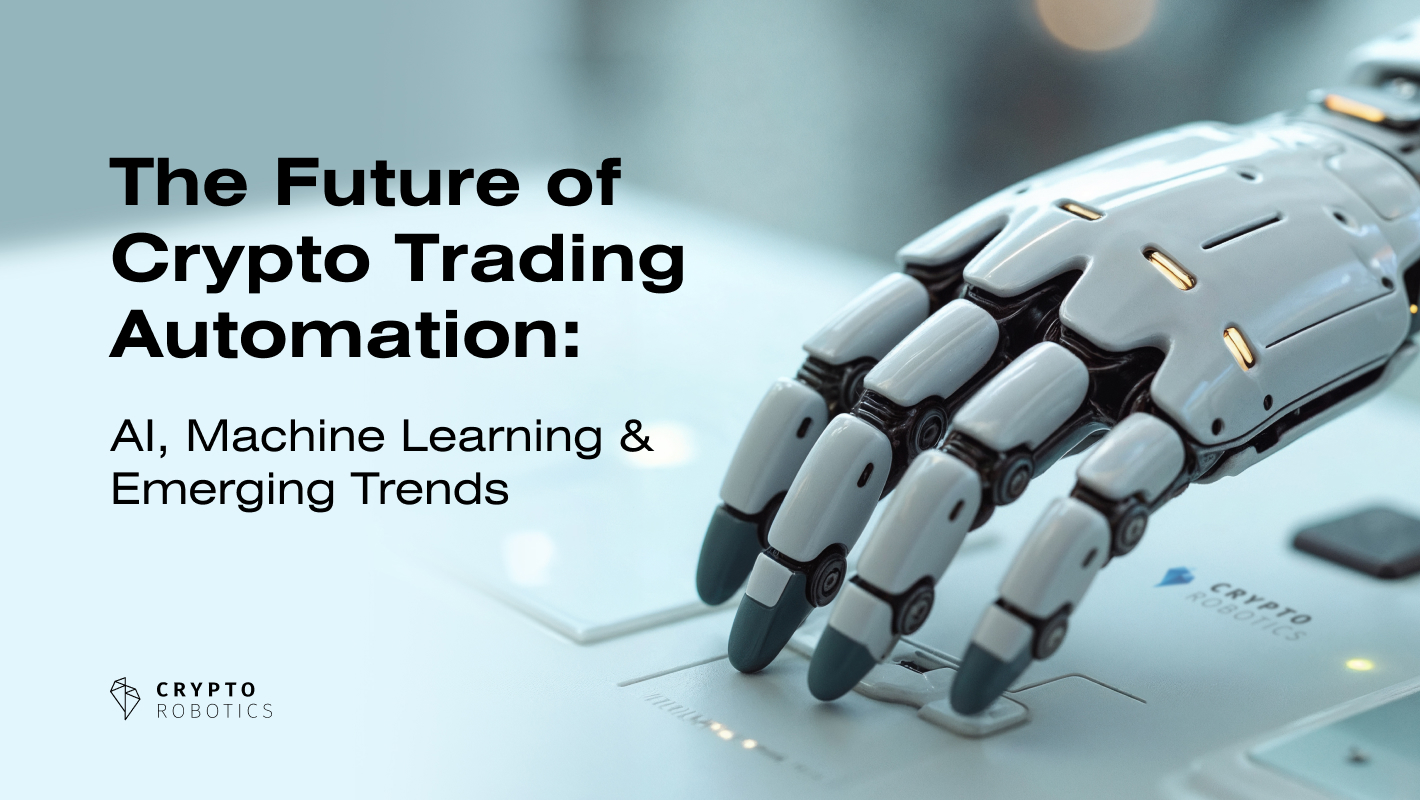


The evolution of the cryptocurrency market has always been inextricably linked with technological progress. While manual strategies dominated the early days of the market, today the competitive advantage has completely shifted towards automation and algorithmic trading. The future of trading, especially in the highly liquid and volatile crypto sphere, belongs to systems capable of processing vast amounts of data, extracting non-linear patterns, and making decisions without human intervention.
Central to this revolution are Artificial Intelligence (AI) and Machine Learning (ML). Unlike classic bots that follow rigid rules (e.g., “Buy if RSI is below 30”), AI systems are capable of adapting, learning from errors, and creating predictive models that were previously inaccessible. In this article, we will examine how AI and ML are changing the landscape of crypto trading, what technological trends traders should monitor, and how unified trading platforms, such as CryptoRobotics, are integrating into this high-tech future.
AI and ML represent a quantum leap compared to traditional, indicator-based bots. The core value of these technologies is the ability to adapt and extract non-linear patterns.
Traditional algo trading is based on deterministic rules (if-then-else). These systems are stable but cannot adapt to changing market conditions (e.g., transitioning from a trend to a sideways range).
ML models (such as Neural Networks or Decision Trees) solve this problem:
One of the most valuable applications of AI is sentiment analysis. The cryptocurrency market is extremely sensitive to news and public opinion (FUD/FOMO).
NLP models process text data from Twitter, Reddit, news agencies, and official project blogs. They are capable of classifying text as “bullish,” “bearish,” or “neutral,” translating qualitative information into a quantitative trading signal.
Algorithms can react to news instantly, in milliseconds. For example, if an AI detects a sudden and strong change in sentiment regarding a major altcoin, it can open a scalping position before the price reacts to mass manual order execution.
The future of automation depends not only on the algorithms themselves but also on the environment in which they operate. Four key trends are changing this environment.
DeFi introduces a new source of liquidity and, consequently, a new class of inefficiencies that can be exploited by bots.
Decentralized exchanges (DEXs), such as Uniswap or PancakeSwap, often suffer from temporary price inefficiencies compared to each other or compared to centralized exchanges (CEXs). Bots using automated arbitrage strategies can instantly profit from these discrepancies.
Advanced bots can utilize Flash Loans to execute complex arbitrage strategies that require huge capital for a single transaction and repay the loan within the same block.
The emergence of Web3 applications and the growth of tokenized Real World Assets (RWA) expand the asset class available for automated trading. Bots will need to learn to analyze not only financial metrics but also on-chain activity indicators, such as TVL (Total Value Locked) in DeFi protocols.
While currently in the research stage, quantum computers have the potential to completely revolutionize algotrading by providing unprecedented computational power to solve problems:
The future of algotrading is a war for Latency. As technology develops, traders will strive for microscopic reductions in the time between receiving data and sending an order.
Advanced systems will require direct access to the exchange’s transaction tape, bypassing standard, slower API interfaces.
In an environment where the market is becoming increasingly fragmented (CEX, DEX, tokenized assets) and technologies are complex (AI, RL), there is an urgent need for a unified, reliable platform that acts as a “dispatcher” and technological intermediary.
A key challenge for the advanced trader is managing multiple accounts on different exchanges, each with its own API, interface, and tools.
The majority of retail traders lack the resources or expertise to develop their own neural networks and RL systems. The role of the aggregator platform is to democratize access to these technologies.
The future of trading platforms goes beyond simple order execution. They are becoming Centers for Analysis and Strategic Development.
The platform must integrate advanced Technical Analysis (TA) tools and Smart Terminals that can automatically set complex orders (Trailing Stop Loss, Multi-target TP)—tools that serve as a “bridge” between manual trading and full automation.
Successful future strategies will be hybrid: AI models will generate signals, and a Smart Terminal or a bot with rigid risk management will handle execution. The platform must support this “human-machine” symbiosis.
The evolution of trading requires a profound methodological shift in the trader’s mindset.
Instead of simple metrics like overall P&L, advanced trading utilizes complex indicators:
In the world of AI and ML, Backtesting (testing on historical data) becomes more sophisticated. Simply running a bot on old data is not enough.
The main risk of ML is Overfitting, where a model “memorizes” historical noise too well and fails to perform on new, “unseen” market data (Out-of-Sample Testing). Platforms provide tools that allow traders to conduct testing across various market phases (trending, ranging) to confirm the algorithm’s robustness.
The future of automated cryptocurrency trading is not just an evolution, but a convergence of technologies: AI systems capable of adaptive forecasting, and infrastructural trends like DeFi and Web3.
The competitive advantage is no longer defined solely by knowledge of indicators, but by technological sophistication and speed of adaptation. Platforms like CryptoRobotics serve as the crucial link, democratizing access to complex ML algorithms, unifying asset management in a fragmented market, and providing traders with the tools to build systematic, robust, and adaptive trading systems ready for the challenges of tomorrow.
Alina Garaeva: a crypto trader, blog author, and head of support at Cryptorobotics. Expert in trading and training.
Alina Tukaeva is a leading expert in the field of cryptocurrencies and FinTech, with extensive experience in business development and project management. Alina is created a training course for beginners in cryptocurrency.
Related Topics






Access the full functionality of CryptoRobotics by downloading the trading app. This app allows you to manage and adjust your best directly from your smartphone or tablet.


News
See more


Blog
See more