
lang
December 2, 2025

Mastering Advanced Crypto Strategies: Deep Dive into Day Trading, Scalping & Volatility Frameworks

Crypto Strategies: Day Trading, Scalping & Volatility Frameworks

The cryptocurrency market, characterized by its asymmetric volatility, presents a unique arena for high-yield speculative trading. While daily fluctuations of 1-2% are considered significant in traditional markets, movements of 5-10% are commonplace in the crypto market—and even greater in less liquid altcoins. For the experienced trader equipped with a rigorous methodology and technological sophistication, this is not just a risk, but a fundamental opportunity for systematic profit extraction.

However, exploiting this extreme volatility requires moving away from intuitive trading toward a strict, systematic framework that encompasses Scalping, Day Trading, and Swing Trading. These strategies demand not only impeccable technical analysis but also technological superiority in order execution and risk management.

Conceptual Foundations: Differentiating Trading Horizons and Mechanisms

The key distinction between these advanced strategies lies in the position holding horizon and, consequently, which market inefficiency mechanism they aim to exploit.

Scalping: Exploiting Market Microstructure and Latency

Scalping operates at the micro-level, where positions are held from a few seconds to a few minutes. The goal is essentially to extract minimal profit from an immediate impulse caused by large orders or their execution, before the market fully corrects the price.

  • Mechanism Exploited: Short-term liquidity imbalance, as well as inefficiencies arising from the activity of High-Frequency Trading (HFT) bots and the breakdown of dense clusters in the order book. A scalper aims to “catch” a minimal move, often within the 0.1%–0.3% range.
  • Analysis and Execution: Scalping relies minimally on classic candlestick charts, focusing on the 1-minute or even tick chart. Its foundation is Order Flow Analysis, which includes reading the Depth of Market (DOM), the Time & Sales tape, and analyzing the Volume Profile. Decisions are made in milliseconds, demanding phenomenal reaction speed and concentration from the trader.
  • Requirements: Critical to success are minimal latency in the API connection and low fees (Maker fees), as well as the ability to utilize high leverage to increase position size without violating the 1% risk rule.

Day Trading: Utilizing Intraday Momentum and Psychological Levels

Day Trading targets wider price swings. Positions are held from minutes to a few hours but must be closed before the end of the trading day to mitigate risks associated with overnight news or morning gaps.

  • Mechanism Exploited: Impulses and momentum confirmed by volume, as well as the predictable market reaction to key psychological and technical levels (round numbers, daily highs/lows). A day trader seeks moves in the 0.5%–3% range.
  • Analysis: Classic Technical Analysis (TA) on medium timeframes (15-minute, 1-hour candles). The trader seeks signal confirmation using momentum indicators (RSI, MACD) and structural analysis (continuation or reversal patterns). Discipline here is the ability to ignore “noise” from lower timeframes.
  • Risk Management: Day traders utilize moderate leverage (5x–20x) and require a high degree of automation for setting SL and TP immediately upon entry.

Swing Trading: Capturing Mid-Term Corrections and Reversals

Swing Trading is an intermediate strategy focused on mid-term “waves” (swings) caused by accumulation/distribution phases that last days or weeks.

  • Mechanism Exploited: Structural trend changes, correctional cycles, and reactions to macro-economic or fundamental events that unfold over an extended period.
  • Analysis: High timeframe analysis (4-hour, daily candles), deep structural analysis, use of Fibonacci retracement levels to identify correction zones (especially 50% and 61.8%), and trend indicators (MA 200) to filter trades against the primary direction. Patience is the key factor here, as the trader must be able to withstand intraday “noise.”

Systematic Frameworks: Risk Management as the Source of Alpha

In the highly volatile crypto market, risk management is not just a defense mechanism; it is a source of Alpha (added return) because it allows the trader to survive the inevitable losing streaks.

Position Sizing and Quantified Risk

The professional approach is built on strictly adhering to the 1-2% risk rule on total trading capital per single trade.

  1. Defining Absolute Risk: The trader pre-determines the dollar amount they are willing to lose (1% of the total account equity).
  2. Quantifying the Position: The position size is calculated based on the Absolute Risk and the Distance to the Stop-Loss, which is technically determined.

This approach, known as Position Sizing, guarantees that even a streak of 10–15 losing trades will not lead to a significant loss of capital, ensuring the mathematical margin of safety for long-term survival.

Advanced Order Management and Protection

In advanced trading, orders must function autonomously.

  • Atomic Execution (Smart Orders): For day trading and scalping, the use of Smart Orders is essential. These allow the trader to define the entire lifecycle of a trade (Entry + SL + TP) in one single action. This OCO (One-Cancels-the-Other) mechanism is necessary to prevent emotional decision-making when the trade is active.
  • Trailing Stop Loss: This tool is indispensable for Day Trading and Swing Trading. It automatically moves the SL, locking in realized profit and allowing the position to capture the full extent of a sudden, volatile trend.

Advanced Volatility Analysis and Confluence Techniques

Successful volatility exploitation requires methods that go beyond simple chart observation.

Momentum Analysis and Volume Validation

In the crypto market, Volume is one of the most reliable filters against false signals.

  • Breakout Confirmation: In Day Trading, a trade entry on a level breakout is considered valid only with a significant, sharp increase in Volume. A breakout on low volume is a classic liquidity trap. The experienced trader waits for the candle to close above the level with high volume or uses the Re-test Trading strategy for a lower-risk entry.
  • ATR Integration: ATR (Average True Range) is used to quantify an asset’s volatility. The trader can dynamically adapt their SL/TP to the current ATR, making them wider during high volatility (to avoid being “wicked out”) and narrower during consolidation periods.

Confluence: The Power of Signal Alignment

Advanced trading is based on confluence—the alignment of several independent signals that increase the probability of a trade’s success.

  1. Structural Confluence: The simultaneous alignment of a static support/resistance level with a dynamic level (e.g., 200 EMA) and a significant Fibonacci retracement level (e.g., the 61.8% Golden Ratio). Entering within such a “zone of strength” has a substantially higher probability of success.
  2. Momentum Confluence: The detection of bearish or bullish RSI/MACD divergence at a structural support/resistance level. This indicates that momentum is weakening precisely in the zone where a structural reversal is anticipated, providing strong confirmation for a Swing Trader’s entry.
  3. Multi-Timeframe Analysis (MTFA): Analysis must always start on a higher timeframe (e.g., Daily) to establish the overall trend direction, and then move down to a lower timeframe (e.g., 15-minute) to pinpoint the exact entry. This ensures the trader is always positioned in the direction of the macro trend.

The Technological Imperative and Psychological Resilience

The greatest threat to advanced strategies is not market volatility, but the human factor and technological constraints.

Requirements for Technological Superiority

For Scalping and Day Trading, any execution delay can erode profits.

  • Low-Latency API: These strategies require a reliable, low-latency API connection to major exchanges. This ensures that algorithms and Smart Orders execute faster than average market participants.
  • Algorithmic Systems: Implementing trading bots for executing repetitive, mechanical strategies eliminates human error. Algorithms can analyze more markets simultaneously than a human and operate 24/7 with absolute discipline.
  • Demo Trading: Any new, advanced strategy (especially those involving high leverage) must first be rigorously tested in a simulator (Demo Trading) under real market conditions before any live capital is risked. This is the only way to calibrate risk parameters and validate the strategy’s mathematical viability.

Psychology: Managing Emotional Drawdown

Advanced traders understand that even the best strategy is subject to inevitable losing streaks (drawdowns).

  • The Stop-Trading Protocol: A clear, pre-defined Stop-Trading protocol is essential. If the daily or weekly loss limit (e.g., 3% of capital) is reached, trading must cease until the next period. This prevents Tilt—the emotional state where a trader attempts to recover losses by dramatically increasing risk.
  • The Trader’s Journal as an Analytical Tool: Every entry, exit, and most importantly, the reason for the trade and the trader’s emotional state at the time, must be meticulously documented. Analysis of the journal, rather than emotion, should be the sole basis for iterative strategy improvement. The journal helps isolate recurring errors in execution, even if the strategy itself is mathematically sound.

Conclusion: Integrating Methodology and Technology

Advanced strategies in the crypto market are less about a set of secret indicators and more about a systematic, scientific approach to managing probability and risk. Success in Scalping, Day Trading, and Swing Trading is achieved through strict adherence to methodology:

  1. Risk Discipline: Unwavering commitment to the 1-2% risk rule per trade, backed by atomic order execution.
  2. Technological Capability: The use of Smart Orders, low-latency APIs, and, where feasible, algorithmic systems for flawless execution, particularly for high-frequency strategies.
  3. Confluence of Analysis: The convergence of volume analysis, momentum indicators, and structural levels to confirm every trade setup.

For traders willing to invest the time in developing and rigorously testing such systems, the high volatility of the crypto market remains one of the most potentially lucrative assets in the financial world.

Previous Post Next Post
Alina Garaeva
About Author

Alina Garaeva: a crypto trader, blog author, and head of support at Cryptorobotics. Expert in trading and training.

Alina Tukaeva
About Proofreader

Alina Tukaeva is a leading expert in the field of cryptocurrencies and FinTech, with extensive experience in business development and project management. Alina is created a training course for beginners in cryptocurrency.

Launch Your Crypto Trading Journey with the CryptoRobotics App

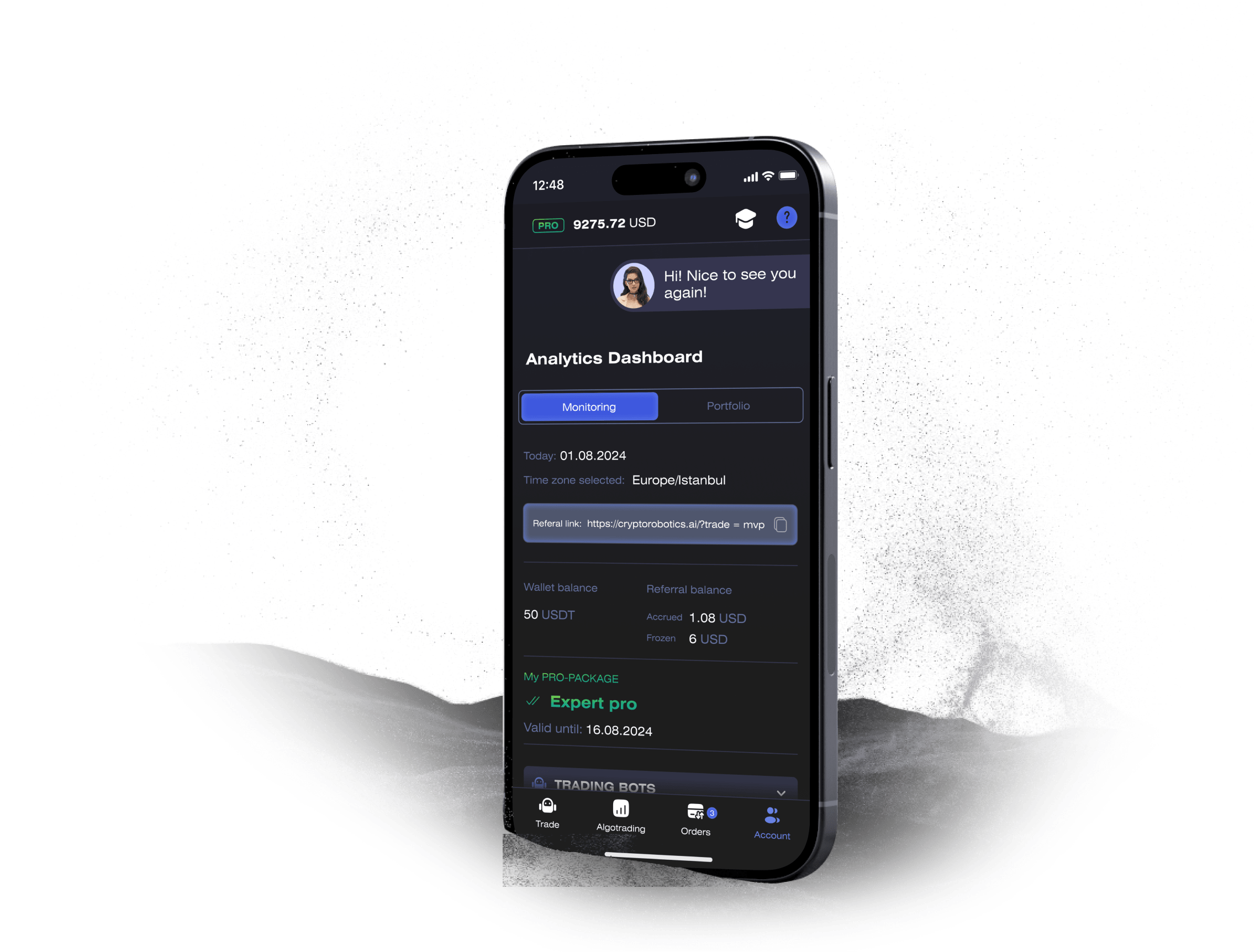
Access the full functionality of CryptoRobotics by downloading the trading app. This app allows you to manage and adjust your best directly from your smartphone or tablet.

phone

Need Assistance on the Platform?

Schedule a personal onboarding session with our manager. He will assist you in setting up the bots, understanding the products, and answer all your questions.